
.png)
.svg)


.svg)
.svg)

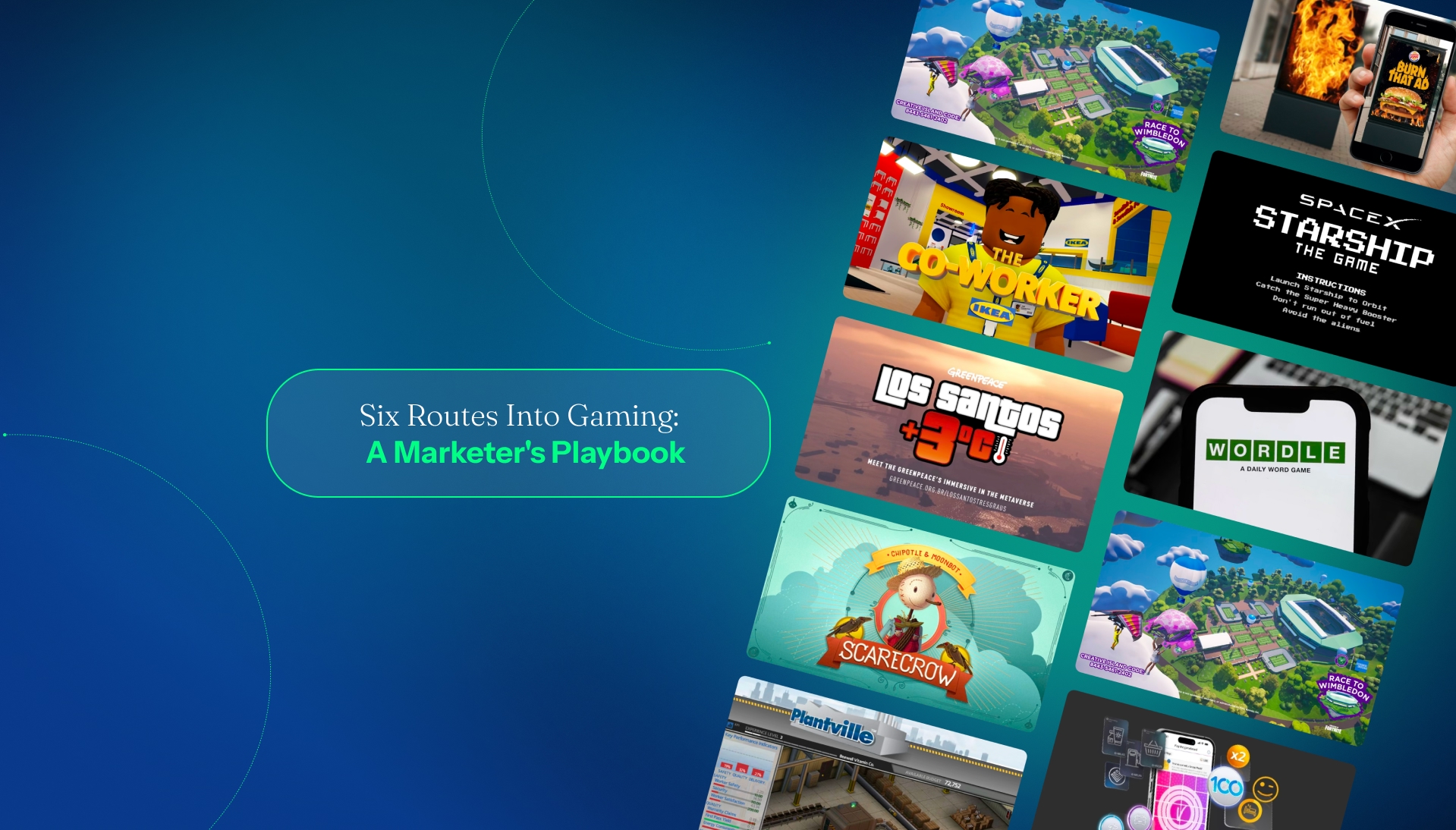
Gaming isn't just one channel, it's six distinct routes. From brand-owned Roblox worlds to in-game ads and loyalty mechanics, this playbook maps how marketers can activate in gaming based on objective, audience, and budget.
Games are increasingly becoming a part of global culture and are demanding attention and reach at massive scale in South Africa and around the world.
No longer a niche experiment sitting in an innovation budget, gaming is a mainstream channel that deserves a standing line in the media mix, right alongside TV, social and OOH. The question marketers should be asking isn't "should we consider gaming?" It's "which of the routes into gaming fits our objective, our audience, and our appetite for build vs. buy?"
Because gaming isn't one channel with one format. It's an ecosystem with clear, distinct ways to show up in it. Here's our breakdown of six routes into gaming, with the local and global brands already proving it works.
(A quick note before we dive in: this article is about video games and interactive entertainment - not gambling. We're talking PlayStation, Roblox, Fortnite and mobile games, not betting apps. The distinction matters for brand safety, and we treat it seriously.)
1. Brand-Owned Experiences
What it is: Building your own standalone game or persistent virtual world - flagship virtual stores, or long-term branded environments designed to be revisited and expanded, not just rented for a campaign burst.
Best for: Deep brand immersion, education, and building a community you actually own. The most resource-intensive route, but the one with the longest payoff.
In action: Locally, Nedbank's Chow Town teaches young South Africans financial skills through running a virtual restaurant on Roblox - 1.6 million+ game visits and an 81% positive rating, alongside a 30% increase in uptake of Nedbank's kids' savings accounts. Globally, IKEA UK's recruitment-led Roblox experience offered ten real, paid virtual jobs in a game and pulled in 178,000+ applications, lifting real-world job applications by 50%.
2. Brand Integrations
What it is: Activating inside an existing, already-popular game or world for a limited window to offer branded avatar items, pop-up zones, or mini-games embedded in someone else's title.
Best for: Test-and-learn campaigns, fast access to an established audience, and tying into seasonal or sponsorship moments without a long production runway. Lower cost and faster to launch than building your own world.
In action: Versace dropped a limited-time, collectible virtual sneaker into Fortnite's Murder Mystery mode, paired with a Twitch event hosted by a popular streamer. The activation generated 29.4 million minutes played and over 1.1 million sneaker claims. On the advocacy side, Greenpeace built a climate-altered version of Los Santos inside Grand Theft Auto, driving an 8-million-minute watch total and a 340% jump in petition signatures.
3. Loyalty and Reward Systems
What it is: Bringing game mechanics (eg. progression, streaks, quests, leaderboards, badges) into your existing loyalty programme so that earning rewards feels playful and meaningful.
Best for: Lifting programme participation, encouraging repeat behaviour, and deepening first-party relationships with customers who choose to engage.
In action: Two strong local examples. Discovery's Vitality Active Rewards gamified physical activity inside its app, driving 46% more active days per month among engaged members. And Pick n Pay's Smart Hopper turned loyalty-point redemption into a one-tap climbing game which achieved 1.6 million+ sessions, a 94% completion rate, and a 22% uplift in spend.
4. Commerce and "Phygital" Activations
What it is: Using gameplay and gamification to drive real, trackable commercial outcomes - virtual-to-physical product twins, click-to-buy mechanics inside the game, and physical rewards earned through play that pull people into stores.
Best for: Conversion-minded campaigns where you need gaming to directly move product or footfall.
In action: Locally, TFG used gamified quizzes and mini-games inside its rewards programme to drive 129,000+ registrations and a 75% voucher redemption rate. Through Roblox, Superdrug drove 15,000 people in-store to claim a free product they'd earned in-game.
5. Dynamic In-Game Advertising
What it is: Scalable, often programmatic ad placements inside games - billboards and posters that blend into the game world, rewarded video, full-screen interstitials between gameplay moments, and non-intrusive audio ads.
Best for: Reach and frequency-managed awareness, bought and traded the way you'd buy any other digital placement. This is the lowest-barrier-to-entry route and a sensible place for most brands to start.
In action: Wiz Khalifa promoted his 2050 Tour through geo-targeted in-game ads across Xbox 360 and PS3 titles, surfacing the offer to gamers in specific US cities and giving them early access to tickets.
6. Influencer and Community Activations
What it is: Tapping the social layer of gaming (streamers, esports teams and community creators) to earn attention through voices players already trust, rather than buying media cold.
Best for: Credibility and authentic entry into gaming culture, especially when your audience is wary of conventional advertising.
In action: When Fortnite launched its "Food Fight" mode, Wendy's joined in to defend its "fresh, never frozen" positioning by raiding in-game burger freezers — live-streamed on Twitch for over nine hours. The result: 1.5 million minutes of content watched and a 119% spike in social mentions, reaching exactly the audience (males 18–24) that the brand needed.
These six routes aren't mutually exclusive - many of the strongest campaigns above combine two or three. Your brand objectives should guide your direction of travel.
What and how to measure success
Gaming activations can now be measured with the same rigour as any other digital channel, but the metric should follow the format, not the other way around.
Gaming's real strength is active, voluntary participation rather than passive impressions, so the most meaningful signals tend to be engagement, time spent, and repeat visits - not just reach.
And because players are actively leaned in, engagement signals can be much more meaningful in games relative to traditional passive channels.
Do you want help mapping the right route to your brand's objective? Get in touch with Sea Monster today!


.gif)
